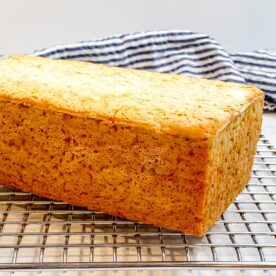
Flourless Brown Rice Yeast Bread (GF, Oil-Free, No Psyllium)
Grab 4 ingredients to make my cheap, easy, fast, flourless brown rice yeast bread! It is psyllium-free, gluten-free, oil-free & vegan.
Servings: 14 (1 loaf)
Ingredients
- 1 lb uncooked (raw) brown rice (any variety)
- 2 tablespoons coconut sugar (see notes for options)
- 2 1/4 teaspoons instant yeast (it MUST be instant/ fast rising yeast)
- 2 teaspoons baking powder (certified GF, as needed)
- 1 teaspoon salt (optional/adjustable)
- 1 1/4 cups WARM water (not cold)
Instructions
- Place the uncooked brown rice in a large mixing bowl. Add boiling water to the bowl (enough to cover the rice by about 1 inch / 2.5 cm).
- Allow the rice to soak for thirty minutes. (See notes for soaking overnight, instead of a fast soak).
- Prepare a 9x5-inch (22.5x12.5 cm) loaf pan. If using a nonstick loaf pan (e.g., silicone), no preparation is needed. Otherwise, line the pan with nonstick parchment paper. If you do not object to oil, spray the pan with nonstick cooking spray, or lightly oil/grease the pan.
- Drain the soaked rice through a colander or mesh sieve and rinse under cold water. Gently shake off the excess water.
- Scrape the soaked, drained rice into a high-speed blender container (see notes for using a regular blender). Add the 1 and 1/4 cups warm water, coconut sugar, and optional salt. Blend on high speed for 90 to 120 seconds until the batter is silky smooth and very warm (it is very important that the batter be very warm to activate the instant yeast).
- Add the instant yeast and baking powder to the blender container. Blend for 15 to 20 seconds until combined.
- Pour the bread batter into the prepared pan. Place the pan in a draft-free warm place. Immediately preheat the oven to 350F (180C). Do not hesitate (the bread rises very quickly. The oven needs to be hot and ready to go as soon as the bread hits the needed rising mark (see next step).
- Let the bread batter rise for 20 to 25 minutes. It happens quickly, so stay close by. The bread is ready to bake as soon as the batter is a short distance away from the the top edge of the pan (the batter should be no closer than 1/4 inch away from the top). (Note: If the batter is all the way to the top, it will overflow the top of the pan once it hits the heat of the oven).
- Bake the bread in the preheated oven for 45 to 50 minutes until crusty in appearance and deep golden brown at the edges. The loaf will be flat on top (no peaks in the center) and somewhat pale towards the middle (even when it is completely baked).
- Let the loaf cool, in the pan, on a cooling rack for 15 minutes.
- Remove the bread from the pan and cool the loaf completely on a wire rack, or other cooling rack.
- Slice the bread, thick or (relatively) thin, as desired. The bread is wonderful plain, toasted, as part of a sandwich, or any way that you prefer!
Notes
Bread Storage: Store the cooled bread in an airtight container at cool room temperature for one day, the refrigerator for one week, or the freezer for up to six months.
Yeast Note: Instant yeast is gluten-free, with the exception of Red Star PLatinum Yeast. It includes enzymes derived from wheat.
Brown Rice Alternatives: Substitute any variety of white rice for the brown rice. Use the same weight of rice.I have only tested this recipe with brown rice. I do not know if any other grains will work. The recipes does not work, as written, with brown rice flour. The recipe will not work with cooked brown rice, either.
Rising Time: The timing for the rise will depend, in part, on the warmth and humidity in your kitchen.
Alternative—Soak Rice Overnight: You are welcome to soak the rice in a more traditional manner. Place the brown rice in the bowl, as described above, but cover with room temperature water. Allow the rice to soak for anywhere from six to twenty four hours.
Bake in a Conventional (radiant heat) Oven: I tested this bread in a conventional oven (radiant heat, not convection). For best results, I recommend using radiant heat, if possible. If you are used to baking bread in a convection oven, you are welcome to experiment with baking the bread in a convection oven. Do not bake the bread in a toaster oven or air fryer (the outside will burn before the bread is baked).
Regular Blender Instead of High Speed Blender: Use warm water, instead of room temperature water, to blend the batter. Stop every 30 seconds to let the blender cool down to avoid overheating the blender. Blend until completely smooth and the batter is very warm. A food processor will not work.
Notes About the Yeast: This particular bread recipe cannot be made without yeast. Also, the bread must be made with instant yeast (also called rapid rise, fast, or quick yeast). It will not work, as written with regular active yeast.
Bread Machines: I have not tested this in a bread machine so I cannot recommend how to make bread machine adaptations to the recipe, or whether it will work.
Coconut Sugar Options: Use an equal amount of maple syrup, agave nectar, molasses, or granulated sugar of your choice to replace the coconut sugar. Do not omit the sugar or use sugar substitutes. Sugar is needed in the recipe to activate (feed) the yeast and make the bread rise.
My bread did not rise as expected. Why?
The most likely reasons are the following.
- Regular yeast was used instead of instant yeast. This recipe will not work with regular yeast. You must use instant yeast.
- Batter was not very warm after blending. The batter needs to be very warm after blending to help activate the yeast.
- Sugar was reduced or eliminated. The sugar was left out, reduced, or replaced with artificial sugar. The sugar is essential for "feeding" the yeast (to produce gas bubbles).
- Oven temperature is off. I regularly check my oven temperature setting using an inexpensive oven thermometer. Check to make sure the oven is accurate before baking. If the oven is too hot, it can force a faster rise to the bread, leading to a bubble under the top of the loaf.
Nutrition
Serving: 1slice | Calories: 98kcal | Carbohydrates: 21g | Protein: 2g | Fat: 1g | Polyunsaturated Fat: 1g | Sodium: 72mg | Fiber: 1g | Sugar: 2g