

This post may contain affiliate links. Please read my disclosure and privacy policy.
This post may contain affiliate links. Please read my disclosure and privacy policy.
Easy high protein vegan sandwich bread made with 4 ingredients! Made with red lentils and sunflower seeds, it is oil-free, grain-free, gluten-free, flourless, sugar-free, yeast-free and (modesty aside) amazing! It boasts 7 grams protein per slice.

Table of Contents
- How Can I Make High Protein Sandwich Bread?
- Recipe Benefits
- Ingredients for Easy High Protein Sandwich Bread
- What are Whole Psyllium Husks?
- Sunflower Seed Kernel Options
- How to Make Easy High Protein Sandwich Bread
- Step One: Rinse the Lentils
- Step Two: Quick-Soak the Lentils and Sunflower Seeds
- Step Three: Preheat the Oven and Prepare the Pan
- Step Four: Blend the Batter
- Step Five: Pour Batter into Pan
- Step Six: Bake the Bread
- Step Seven: Remove from Pan & Cool
- Slice it Thick or Thin
- What is the texture & taste of the bread?
- FAQ
- How should I store the Easy High Protein Sandwich Bread ?
- Can I use other varieties of lentils in place of red lentils?
- My oven has a convection setting. Should I use it for this bread?
- My bread came out gooey in the middle. Why?
- Can I Use Something Other than Whole Psyllium Husks?
- Related Recipes:
- Easy High Protein Sandwich Bread (V, GF, oil-free) Recipe
How Can I Make High Protein Sandwich Bread?
With 4 frugal ingredients and very little effort ?!
You don’t need flour, yeast, grains, fancy equipment, or bread-baking experience. Just some red lentils and sunflower seeds.
It sounds wacky, I know. But wacky can be wonderful.

Recipe Benefits
This easy high protein sandwich bread is all of the following, and so much more:
- High in protein (7 grams per slice)
- High in fiber (6 grams per slice)
- Vegan (egg-free & dairy-free}
- Oil-free
- Made with 4 ingredients
- Grain-free
- Gluten-free
- Flourless (made from red lentils & sunflower seed kernels)
- Yeast-free
- Xanthan gum-free
- Sugar-free
- Nut-free
- Minimal ingredients
- Easy to prepare
Cue the happy dance!
Ingredients for Easy High Protein Sandwich Bread
The exact amounts of each ingredient are indicated in the recipe card at the end of the post.

The ingredients for the bread are basic and frugal:
- Red lentils
- Sunflower seed kernels (shelled sunflower seeds)
- Whole psyllium husks
- Baking powder
You will also need some water (I use filtered tap water, but use what you prefer) and (optional) salt.
What are Whole Psyllium Husks?
Psyllium is a plant product derived from the husks of the seeds from the Plantago ovata plant. When combined with liquid, the husks swell, creating a gelatin. The gel can be used in ways similar to eggs, and also stands in for gluten (creating structure) in gluten-free and grain-free breads.

I order whole psyllium husks online. You can search for them on any search engine and find multiple purveyors. You may also be able to find them in a well-stocked natural foods grocery store.
Store the psyllium husks in an airtight container and it will last for years, making it a frugal buy. Plus once you have it, you can make all kinds of amazing gluten-free vegan breads, such as my 100% Millet Sandwich Bread, Easy Multigrain Sandwich Bread, Coconut Flour Sandwich Bread, 100% Millet Banana Bread, Buckwheat Sandwich Bread, Oat Sandwich Bread, 4-Ingredient Power Bread, and more!
Sunflower Seed Kernel Options
I use raw sunflower seed kernels for the recipe, but you can also use roasted sunflower seed kernels. If you choose roasted and salted sunflower seeds, reduce the added salt by 1/8 to 1/4 teaspoon.

The sunflower seeds have a three-fold function in this easy, minimalist bread:
- Structure. The protein and fiber in the seeds contribute to the bread’s shape and texture.
- Oil-Free Fat. The natural oils in the sunflower seeds allow this bread to to be free of oil, yet still tender.
- Flavor. Sunflower seeds have a faintly nutty, yet neutral flavor, which is enhanced by the long slow bake. Use roasted seeds for richer flavor, or stick with raw seeds for an especially mild flavor.
How to Make Easy High Protein Sandwich Bread
Note that the complete directions are also in the recipe card below.
Step One: Rinse the Lentils
Place the lentils in a colander or mesh sieve and rinse under cold water. This removes any dust or debris from the dried lentils. No one wants dusty bread.
Step Two: Quick-Soak the Lentils and Sunflower Seeds
Combine the lentils, sunflower seeds and boiling water in the container of a blender (regular or high-speed). Let stand for 20 minutes until the lentils are plump (the seeds will also plump, slightly) and the water has cooled. Do not drain.
If you prefer, you can soak the lentils and sunflower seeds in the same amount of cool water for 12 to 24 hours.
Step Three: Preheat the Oven and Prepare the Pan
Preheat the oven to 325F (160C). If your oven has a convection setting, do not use it for this bread. This bread is best when baked using the regular (convection) heat. More about this in the FAQS at the end of the post.
Spray a 9×5-inch (22.5 x12.5 cm) loaf pan with nonstick cooking spray. Alternatively, lightly oil or grease the pan. If you want to avoid any and all oil I suggest using a high quality non-stick loaf pan.
Step Four: Blend the Batter
Blend the plumped lentils, sunflower seeds and cooled water on high speed, stopping once or twice to scrape down the sides of the blender container, until smooth.
Add the whole psyllium husks, baking powder, and optional salt to the blender. Blend for 10 to 15 seconds until blended.

Step Five: Pour Batter into Pan
Scrape the batter into the prepared pan. Smooth out the top of the batter. The batter will have a texture similar to that of thick pancake batter.

Step Six: Bake the Bread
Bake the bread in the preheated 325F (160C) oven for 90 minutes until risen and the surface of the bread appears dark golden brown, dry, and crusty. The bread will also sound hollow when tapped.

Transfer the pan to a cooling rack. Cool the bread in the pan for 15 minutes.

Step Seven: Remove from Pan & Cool
Remove the loaf of bread from the pan (slide a butter knife around sides, as needed, to assist the release). Place the loaf on the cooling rack and cool completely.
You have never seen lentils and sunflower seeds quite like this ?.

Slice it Thick or Thin
This is a sturdy bread with minimal crumbs when sliced (do make sure it is completely cool before slicing). The loaf can be sliced into thick, hearty pieces:

It can also be sliced very thin, without falling apart or crumbling.

What is the texture & taste of the bread?
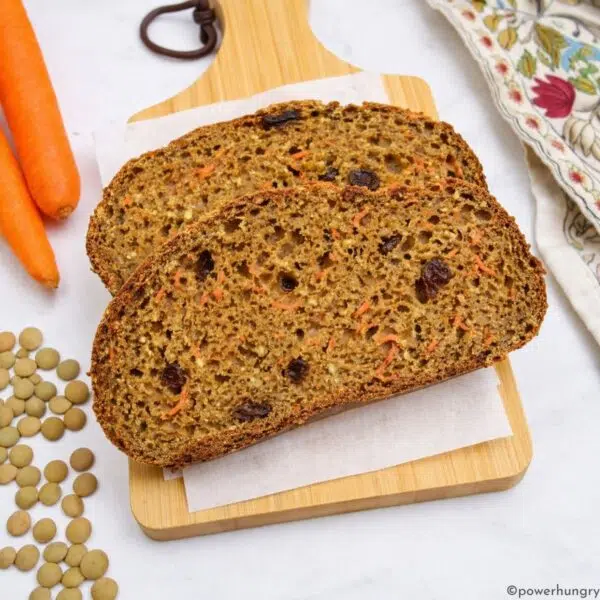
First, texture: The bread is very much like a fine-textured whole grain bread. It is hearty, but soft with a pleasing crumb. The high protein and high fiber of a single slice means that is also very filling.
Taste: The flavor of the bread is very much like a full flavor multigrain bread. It is excellent straight up, or toast it to enhance the already nutty flavor of the bread.
The bread is wonderful for toast, sandwiches, and accompanying meals of all kinds. Both sweet and savory fillings are delicious in combination with the whole grain-like flavor of this bread. Here it is with my easy cashew cream cheese and some sliced strawberries (so yum!).

FAQ
How should I store the Easy High Protein Sandwich Bread ?
Store the cooled bread in an airtight container at cool room temperature for 2 days, the refrigerator for 1 week, and the freezer for up to 6 months.
Can I use other varieties of lentils in place of red lentils?
Most likely, yes. However, I recommend sticking with red lentils (Note that I have only tested the bread with red lentils). In general, red lentils produce a lighter flavor and texture in baked goods than darker lentils.
If you choose to use another variety of lentils, use the same weight as the red lentils. If the easy high protein sandwich bread is made with brown, black or green lentils will likely be slightly denser and darker than loaves made with red lentils.
My oven has a convection setting. Should I use it for this bread?
I do not recommend it. Convection ovens excel at quick, crisp cooking. They are not the right choice for long slow baking, and that is definitely the case for this bread.
Convection ovens (or the convection oven setting) can force the outer layer of this bread to rise and separate from the inside of the bread. This will lead to several results: (1) a big bubble under the surface of the loaf; (2) a gooey middle and bottom; and (3) a hard outer crust.
This bread needs the low, slow radiant heat of a conventional oven.
My bread came out gooey in the middle. Why?
The bread should not be gooey at all. But if it happens, possible reasons are as follows:
- Baking in a a convection oven instead of conventional oven. See the section above explaining why this makes a huge difference.
- Inaccurate measurements. Even if you have been baking since forever, it is possible that you mis-measured. It is easy to get distracted for a split second–it happens to everybody! If you measured using cups, I urge using a scale next time around. You will love using the scale to measure once you start.
- Oven temperature is off. I regularly check my oven temperature setting using an inexpensive oven thermometer. Check to make sure the oven is accurate before baking. If the oven is too hot, it can force a faster rise to the bread, leading to a bubble under the top of the loaf.
Can I Use Something Other than Whole Psyllium Husks?
No, for this recipe it must be whole psyllium husks. Other gelling agents, such as flaxseed meal or chia seeds, will not work as direct substitutes (they might work, but it would involve some experimenting to determine their efficacy).
I have not tested the recipe with psyllium powder. It can work as a substitute for the whole husks in some recipes. If you try the bread with psyllium powder, you will need to use an equivalent weight (15 grams), which is significantly less volume than the whole husks. Check the label of your brand of psyllium husk powder, or use a kitchen scale.
Happy baking! I hope that you love this bread s much as I do.
Related Recipes:

Easy High Protein Sandwich Bread (V, GF, oil-free)
Ingredients
- 1 and 1/4 cups, 235 g red lentils (uncooked)
- 1 and 1/4 cups, 150 g sunflower seed kernels
- 2 and 1/2 cups, 591 mL water
- 3 tablespoons 15 g whole psyllium husks
- 1 tablespoon 14 g baking powder
- Optional: 3/4 teaspoon salt
Instructions
- Place the lentils in a colander or mesh sieve and rinse under cold water. This removes any dust or debris from the dried lentils.
- Combine the lentils, sunflower seeds and boiling water in the container of a blender (regular or high-speed). Let stand for 20 minutes until the lentils are plump (the seeds will also plump, slightly) and the water has cooled. Do not drain.
- Preheat the oven to 325F (160C). Spray a 9×5-inch (22.5 x12.5 cm) loaf pan with nonstick cooking spray. Alternatively, lightly oil or grease the pan.
- Blend the plumped lentils, sunflower seeds and cooled water on high speed, stopping once or twice to scrape down the sides of the blender container, until smooth.
- Add the whole psyllium husks, baking powder, and optional salt to the blender. Blend for 10 to 15 seconds until blended.
- Scrape the batter into the prepared pan. Smooth out the top of the batter.
- Bake the bread in the preheated 325F (160C) oven for 90 minutes until risen and the surface of the bread appears dark golden brown, dry, and crusty. The bread will also sound hollow when tapped.
- Transfer the pan to a cooling rack. Cool the bread in the pan for 15 minutes.
- Remove the loaf of bread from the pan (slide a butter knife around sides, as needed, to assist the release). Place the loaf on the cooling rack and cool completely.
- Slice the cooled bread thick, thin, or anywhere in between! It is wonderful for toast, sandwiches, and accompanying meals of all kinds.


This looks like something I NEED to try! Would split dried red lentils work? I have those in the house.
Hi Julee! I am so glad this recipe appeals! I love it, it has a great flavor and texture. Yes, you can definitely use split red lentils, that’s what I use here. Pretty much all red lentils sold in the US are “split,” unless you are buying red lentils in an Indian or other International grocery store :). I’d love to know if you give the recipe a try!
Absolutely LOOOOOVED this!!! Looks just like bread! My biggest and only “problem”… I find that red lentils taste like beans. I don’t like beans. When I cook them in other recipes, I flavor them with other seasonings. I was thinking garlic. Any and all suggestions would be greatly appreciated!
Hi! I just tried this recipe and my loaf came out looking almost black – it tasted fine – slightly mushy – from the convection from what I’ve read in the comments. The color though is so different than your picture! What could have gone awry?
Hi Joanne,
I’m glad you tried the bread and liked it— but I am scratching my head regarding the black color. We’re you using darker lentils?
Something weird happened. Measured everything and have a normal gas oven and an inside thermometer. Its hollow. Has a crust but empty ans the rest is dense and weighed in the bottom!!!
Hi Veronica,
oh no, sorry to hear that. Any chance that you are using a fan oven/convection oven? This bread needs to be baked in a radiant heat (traditional) oven. The fan function of a convection oven can cause the top of the bread to rise too quickly, leaving the bottom too dense below.
Hi ,
Made this bread today. Did weigh out everything. Baked in traditional oven. Actually baked 20 minutes longer. After removal from pan I still got the sunk in soggy middle. Any other suggestions?
Hi Linn,
Oh no, I’m sorry to hear that. Have you tested your baking powder recently to see if it is active? Was your pan a 9×5 inch (or was it smaller, and hence deeper?) did you use whole psyllium husks?
Could this recipe be adapted to use lupina flour instead of the red lentils? Would increasing the liquid in the recipe help offset the higher protein & lower carb content of lupina? Finding lower calorie + gluten free bread recipes is immensely difficult and this recipe seems really promising!
Hi Cynthia,
I have not used lupine flour before— but just ordered some because your comment reminded me that I want to experiment with it. Alas, I cannot advise about subbing it here, but you could experiment by adding the same weight of lupine flour as lentils and adding several tablespoons more flour.
Could one allow the time while soaking the lentils and seeds to wait for them to sprout before using? And just out of curiosity…do the lentils have to be red? (Here I am assuming there are other lentil colors.)
Hi Gee,
You can indeed use other lentils (any color, they come in many shades). I have really never done sprouting, but from what I have read about it, that should be fine (i.e., it will not change the structure of the bread, recipe requirements/measurements). Cheers!
Hi Camilla,
Hi I just wanted to say thank you for this recipe. I make it almost every week – have a loaf in the oven now! We all love it. I do not eat sunflower seeds so I alternate the recipe with green pumpkin seeds and hemp hearts. Thanks again!
Hello,
The bread rose very well similar to your pic but to my surprise it was hollow at the top and dense and gluey at the bottom as if it did not bake well. Could not use it. Any idea why this would have happened? I have a gas oven and had set the temperature approx around 170-180 degrees. Really liked the taste and want to try again. Any suggestions for next time
Hi Karishma,
I’m so sorry the bread did not bake properly. Is your oven convection heat, or was it set to convection (as opposed to traditional, radiant heat)? Your issue sounds like what others have had in baking psyllium breads with convection. Convection causes a quick rise (hence the bubble, leaving a dense bottom). Convection is great for quicker bakes, like cookies and biscuits, but long baking, alternative breads like this need the consistency of radiant heat for a proper, even rise.
Hi Camilla,
I am planning to buy a new oven. Can you please advise what brand and specifications should I look for.
Hi Karishma! I apologies, but that’s not my area of expertise. I have a conventional oven that uses radiant heat (as opposed to a convection oven). Most recipes, on my site and elsewhere, assume that a radiant heat oven is being used, so it is probably a good idea to get one that uses radiant heat (perhaps with convection as an option).
The bread is wonderful! I used an 8×4 inch baking pan and it came out just like the photo. Thanks!
Hello,
Any suggestions to substitute sunflower seeds? I cannot use nuts or seeds. Also, can I use baking soda instead of baking powder?
Hi Alex,
I cannot think of another sub that would work here that isn’t a nut or seed. But you can make my Lentil Sandwich Bread instead (no nuts or seeds). You can use red lentils for a lighter flavor and texture. It is still very high in protein. If you do not eat oil, you can replace the 1 tablespoon of oil in the recipe with an additional tablespoon of water 🙂 Here is the post with the recipe : https://www.powerhungry.com/2019/03/5-ingredient-lentil-loaf-bread-grain-free-vegan/
This is such a wonderful bread! I love the taste, the texture and how easy it is to make. Mine looked just like yours, but I have also made this with green lentils (success!) and it is darker brown and still wonderful. Thank you for this unique delicious and inexpensive recipe!!!
I am so happy this bread works for you, Lidia! And thanks for the update abut the green lentils, that is great to know that green lentils worked well in the recipe 🙂
Kicking myself for not weighing out the lentils and the sunflower seeds as someone else mentioned in the comments here, tsk tsk! I was too excited to get this bread in the oven. Needless to say, the bread is superb! It was a wee bit stodgy in the middle and collapsed, hoping weighing out the dry ingredients will help with that. Still tasty as can be with a delightful crust. Will be making this again.
Love love loving your recipes, Camilla!
I am so glad you liked the bread, Annie!
Loved this bread. I’ve made it twice. Instead of a loaf pan, I use dollops on a sheet pan with parchment to make individual little flat breads for sandwiches for a shorter cooking time of about 20 min. However today, my batter turned green after sitting between batches, and the batch came out dark like a pumpernickel bread— then while sitting on cooling rack, within a couple hours, turned super dark green! Smells and tastes normal, but soo odd! Should I even eat it?? Any ideas?
Hi Cheryl! So happy you like the bread!
Ah yes, green bread! I know, it is bizarre, but the color is completely harmless. It is caused by a chemical reaction from the chlorogenic acid (a healthy polyphenol) in sunflower seeds. When sunflower seeds are crushed (flour, seed butter), they react with themselves. But the reaction turns wild when enhanced by the alkalinity of baking soda. I write about this in my Sunflower Seed Bread Post (green bread photos included in the post! ?)
Acid in the batter will prevent the green, so using baking powder instead of soda typically keep things a neutral brown–baking powder has cram of tartar, an acid). I am wondering if your baking powder may have had a lower amount of cream of tartar? But that does not sound likely. If you were using the same baking powder as before, you can still prevent the green by adding a tablespoon of lemon juice or vinegar to the batter ?
Note that the green-sit blue bread is a most excellent offering for Halloween & April Fool’s day ?
@Camilla, OMGosh-Thank you for answering that! Too funny 😂
Love your blog, btw!! 🥰
It’s a place a turn to very often. 👍🏼👍🏼
Thanks so much, Cheryl! 😊
I made this today in a solar oven at 7,000 feet. Used 2 t. baking powder instead of 3 t. as a high altitude adaptation.
I really liked the bread.
Thanks for all the creative recipes!
You are so welcome, Karina! And wow, so neat re: the solar oven!
Can you use a glass loaf pan 8.5”x5.5”x2.5” (1.6qt) to make this bread?
Hi Carol,
Yes, absolutely! Glass, metal or ceramic, all will work 🙂
Hi! I hope this comment shows up… so many of my past ones have not🙁
I am SO excited about this bread!
I went to weigh and prep the lentils and seeds this evening and found that for BOTH of them, the weight that matched your instructions was just barely over a cup. I’m now nervous that the water amount will be too much given that there is no weight for that and the solid matter is almost a full 1/2c less than—or only 4/5 the total of—the measured dry amounts.
You always encourage weighing but this discrepancy is so big that I’m pretty stumped for the best course of action. Any advice?
Hi Eve,
If the weight is correct, everything should be fine.There is variation between various brands (looking at their nutrition labels) about hw many grams are in a 1/4 cup amount for these two ingredients (for example, my package of bobs red mill red lentils say that 1/4 cup dry is 50 grams, my bag of Kroger bread red lentils says that 1/4 cup dry is 35 grams, and my bag of Goya brand red lentils say 1/4 cup dry is 45 grams.) If your weight is correct, it should be fine, that’s what I used (weight). But with this bread, even some wiggle room (if using dry measures), the bread will be fine :).
It is standard for waater and other liquids to be given in volume amounts (mL), not weight 🙂
Cheers, hope you like the bread!
@Camilla, thank you😊
(and I hope somehow my very long comment about how your oat sandwich bread meant so much to my sister somehow got to you even though it’s not visible on the page)💗
Is it possible to drain the water off of the soaked sunflower seeds, and red lentils, then MEASURE the water that was drained off, and add instead fresh water of the EXACT same amount. The reason would be to get rid of the phytates and lectins that are in all seeds and legumes unless soaked.
Hi Cheryl,
Certainly, you are welcome to do that. Keep in mind, too, that soaking is just one of multiple ways that phytates and lectins are broken down. Baking the soaked seeds and lentils in a dough (like this bread batter) reduces lectins and phytates to a negligible level.
@Camilla, I think sprouting reduces them as well.
@Gee thank you!
No need to reply on the ground psyllium as it worked wonders! This bread not only looked and tasted great, but we felt so good after eating it!! Thanks so much for sharing the recipe
Oh wow, that is wonderful, Marlene!!! Thanks so much for sharing that you had success with psyllium powder 😊
can psyllium ground be used instead of the husks?
I have not tried it, but most likely you could use an equivalent weight of psyllium powder (i.e., ground husks)
I noticed the mL on the water was quite a bit of less than 2-1/2 cups. Which is correct? Thank you.
Thank you so much for catching that, Cynthia— I typed a 2 instead of a 5 in the mL. Corrected! Thanks so much 😊