

This post may contain affiliate links. Please read my disclosure and privacy policy.
This post may contain affiliate links. Please read my disclosure and privacy policy.
No need to hunt for, or pay a lot, for grain-free powdered sugar. You can make it yourself, in seconds, with a high speed blender or coffee grinder! It is also corn-free, gluten-free, and can be made with the natural sugar of your choice.

Table of Contents
- Grain-Free, Gluten-Free, Corn Free Powdered Sugar
- Ingredients for DIY Grain-Free Powdered Sugar
- Equipment for DIY Grain-Free Powdered Sugar
- How to Make Grain-Free Powdered Sugar
- How to Use Grain-Free Powdered Sugar
- How to Store Grain-Free Powdered Sugar
- More DIY Basics to Make (& Love)
- Grain-Free Powdered Sugar {gluten-free, easy} Recipe
Grain-Free, Gluten-Free, Corn Free Powdered Sugar
Powdered sugar–also known as confectioners’ sugar or icing sugar–is granulated white sugar that has been crushed to a powder and then combined with a bit of cornstarch (to prevent caking). When you need some powdered sugar (for a simple glaze or icing), few other things will do.
So what’s the solution if you:
- cannot (or do not) eat grains (in particular, corn)
- want to ensure that the powdered sugar is 100% gluten-free
- prefer to avoid highly processed white sugars
You can solve the first two problems by searching high and low for one of the few brands of gluten-free powdered sugar (and then paying mightily once found).
Alternatively, you can resolve all three issues by making your own powdered sugar–in seconds–at home. Easy (check), cheap (check), and fast (check)!
Ingredients for DIY Grain-Free Powdered Sugar

To make your own grain-free powdered sugar, you will need the following ingredients:
- Granulated sugar (e.g., coconut sugar or natural cane sugar)
- Tapioca flour, arrowroot powder or potato starch
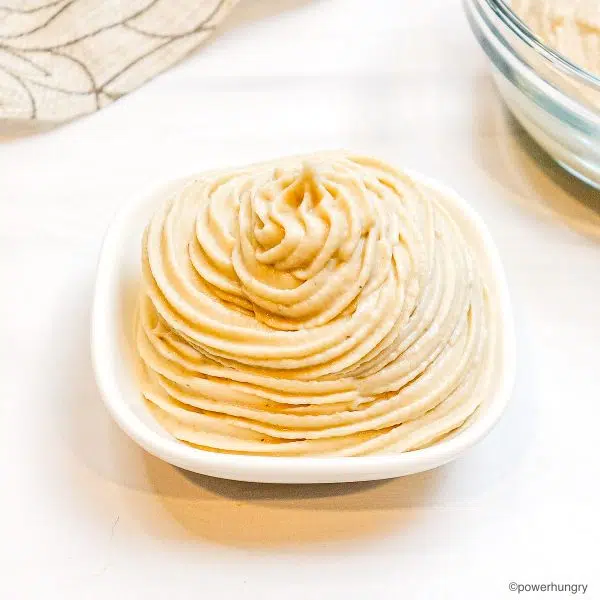
The beauty of doing it yourself is that you control the type of sugar. For example, you can make powdered coconut sugar. Sure, it is tan instead of white (which may not be suitable for all recipeS), but wow, what a great flavor! Mix it with a bit of nondairy milk and you have an instant, caramel-y icing (yes, please!).
If you need a whiter powdered sugar, you still have less processed options, such as natural cane sugar. If processed sugar is not a concern, you can always stick with regular white granulated sugar.
Equipment for DIY Grain-Free Powdered Sugar
To make powdered sugar at home, you will either need a:
- Blender (ideally high-speed, but traditional works, too)
or
- Electric coffee grinder (wiped clean of any coffee residue)
The objective is to pulverize the sugar into powder, so the more powerful the equipment, the more powdery the result. A coffee grinder will take longer, since only a small amount can be pulverized at a time, but it can still produce great results.
How to Make Grain-Free Powdered Sugar
Place the sugar and the starch in the blender or coffee grinder.
For the coffee grinder option (as pictured below), grind 1/4 cup of sugar at a time. I add all of the starch in the first batch and then grind the remaining sugar (and then stir together all of the ground sugar at the end).

For blenders: Cover the container and process on the highest setting until powdery. It will take about 30 seconds in a high speed blender (about 2 minutes in a standard blender).
For coffee grinders: Cover and process, shaking the grinder to distribute the ingredients, until powdery (it will take about 2 minutes, max). Transfer to a bowl or container and repeat with the remaining sugar. Stir to combine all of ground sugar once finished.

And that, my friends, is that! You’ve got grain-free, cornstarch-free, gluten-free powdered sugar, ready to use immediately or store for future use.

How to Use Grain-Free Powdered Sugar
Use the grain-free powdered sugar as a measure for measure replacement for traditional powdered sugar. As mentioned above, the coconut sugar version is light brown in color. Use the cane sugar or regular white sugar option if a white powdered sugar is needed for the intended recipe.
How to Store Grain-Free Powdered Sugar
Store the powdered sugar in an airtight container for up to 6 months.
Like store-bought powdered sugar, grain-free powdered sugar may clump slightly the longer it is stored (the added starch absorbs moisure, leading to clumps). For best results, sift before using.
Enjoy!
More DIY Basics to Make (& Love)
- 4-Ingredient Chickpea Flour Mayonnaise (vegan, soy-free)
- 1-ingredient Pepita Butter {vegan, keto}
- DIY Sunflower Seed Flour (nut-free, keto)
- Vegan Parmesan Cheese (made with cashews or hemp hearts)
- Easy Cashew Mayonnaise {4 ingredients, vegan, Paleo, oil-free}
- DIY Sunflower Seed Butter {oil-free, easy, keto option}

Grain-Free Powdered Sugar {gluten-free, easy}
Ingredients
- 1 cup 192 g natural cane sugar or 1 and 1/3 cups (190 g) coconut sugar
- 1 tablespoon 22 grams tapioca starch (see note for options)
Instructions
Blender:
- Place the sugar and the starch in the blender or coffee grinder.
- Cover the container and process on the highest setting until powdery. It will take about 30 seconds in a high speed blender (about 2 minutes in a standard blender).
- Transfer to an airtight container.
Coffee Grinder:
- Place 1/4 cup of sugar in the grinder; add all of the tapioca starch.
- Cover and process, shaking the grinder to distribute the ingredients, until powdery (it will take about 2 minutes, max).
- Transfer to an airtight container and repeat with the remaining sugar. Stir to combine all of ground sugar once finished.



Hello, if I use a small amount of tapioca will it be safe to consume uncooked? I remember reading that it contains cyanide when consumed uncooked but maybe it’s not a big deal in the states? I was making a sweet bread that called for a thick coating of icing sugar or powdered sugar on top and it said to incorporate extra starch so its not so sweet. Im making it for my sister in law who is pregnant though so I just wanted to make sure it would still be safe for her. Thanks!
Hi Meredith,
Yes, it is safe to consumer with tapioca flour. There are natural traces of cyanide in a number of foods, such as cassava (from which tapioca is derived), but you would have to eat massive quantities of tapioca for it to be harmful. Cheers.
This is exactly what I was looking for, thank you!!!! Made with coconut sugar, it turned out great.
Excellent, Sandra!
Thank you for this simple solution, Camilla!
This is so easy, I absolutely love the coconut sugar version. Use a high speed blender if you have it, comes out super light and powdery